What Is Freemasonry?
Freemasonry is the regular gathering of men with a like disposition or purpose who meet in a fraternal & social environment. Becoming a freemason teaches its members a moral & ethical approach to life, with three key principles:
Brotherly Love – Showing tolerance & respect for the opinions of
others & to extend kindness & understanding in all your actions.
Relief – To be a practitioner in charity, not solely within your
immediate family but also to extend into the community by voluntarily
giving to the needy.
Truth – Always being truthful & seeking to attain moral
standards to its highest level throughout your life in all you do.
Freemasonry is one of the oldest, non-religious & non-political fraternities in the world, though there is an essential requirement for its members to have a belief in a ‘Supreme Being’ in any denomination. There has been some debate as to the origins of the organisation, though Masonic scholars generally agree that it descends from the institution of operative stone masons responsible for the construction of the great castles & cathedrals during the middle ages.
There is evidence dating back to the 1660’s of men being initiated into non-operative lodges. Elias Ashmole recorded in 1646 – ‘October 16, 4.30pm – I was made a freemason at Warrington in Lancashire with Colonel Henry Mainwaring
[a Roundhead parliamentarian friend related to his father-in-law] of Karincham in Cheshire. The names of those that were then at the Lodge, Mr. Richard Penket Worden, Mr. James Collier, Mr. Richard Sankey, Henry Littler, John Ellam, Richard Ellam and Hugh Brewer.’ (Cited from the U.G.L.E.)
On 24th June 1717, at the ‘Goose and Gridiron’ alehouse in St. Paul’s Churchyard, four London Lodges gathered to form the Grand Lodge of England. This saw the birth of the first freemasonry governing body with Anthony Sayer elected as their Grand Master. London Lodges, specifically those within a 10-mile radius of Charing Cross, were the only Lodges that fell within the jurisdiction of Grand Lodge.
It was not long afterwards that Ireland and Scotland formed their own Grand Lodges in 1725 & 1736 & between the three, Freemasonry was introduced in other countries overseas. A rival Grand Lodge formed in London in 1751, its originators being Irish Masons. They gave reference to the original London Grand Lodge as the ‘Moderns’ regarding themselves as the ‘Ancients’. Both Lodges had a parallel existence for some 60 years, neither given recognition to the other. However, in 1813 following substantial negotiation the two Grand Lodges amalgamated to form what is known as the United Grand Lodge of England (U.G.L.E.) This allowed the standardisation of procedures, regalia & rituals.
The years that followed saw the expansion of Freemasonry across England & Wales & the formation of Provincial Grand Lodges. However, the administration of Freemasonry in London was controlled by The Grand Secretary’s Office & remained separate from the Provincial structure. During the late 1800’s to early 1900’s the population of London more than doubled & in turn many new London Lodges were formed. A larger building was required to manage this increase & so the Modern Freemasons’ Hall in Great Queens Street was constructed in memory of those who fell during World War I.
During the Second World War, anti-masonic propaganda emerged from Nazi Germany & Franco’s Spain. Freemasonry was banned in both countries & its members either imprisoned or killed. The same fate awaited English Freemasons if the Nazis were able to invade. This was evident with the invasion of the Channel Islands, where Masonic Temples were ransacked & its members captured. With this English Freemasonry was forced into privacy to protect its members, where it remained even for some years after peace time. However, since 1984 The U.G.L.E. has actively pursued a policy of openness returning freemasonry into the visible community. The organisation stands as one of the leading contributors to charity.
In the 1990’s the Grand Master, HRH Duke of Kent, commissioned a formal review into establishing a London Province to support London Freemasonry. It would act as an independent administrative body in the same way Provincial Grand Lodges support Freemasonry across their respective counties. This was not a new idea as plans for a London Province date back to the late 1700’s. On the 1st October 2003 the outcome of the review saw the formation of Metropolitan Grand Lodge (MetGL) who support over 1,400 constituent Lodges and nearly 40,000 members in London.
History of the 'Forget-Me-Not' Symbol
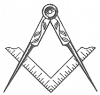
There are many symbols associated with Freemasonry, the Square & Compasses probably being the most famous. Another Emlem that deserves a mention is the 'Forget-Me-Not'. As was written above, in 1934, just after Hitler took power in Germany, it was apparent & proven that freemasonry was in danger. This danger was recognised by one of the pre-war German Grand Lodges in Bayreuth, 'The Grand Lodge of the Sun.' It's Brethren chose to wear the 'Forget-Me-Not' flower, an already known charitable symbol (Das Vergissmeinnicht), in lieu of the traditional Square & Compasses as an indication of freemasonry.
We already know that the Nazis were ransacking Masonic Temples, confiscating & destroying Masonic property as well as capturing Brethren, which drove Masonry underground. So, as means of Masons being able to identify each other & being an innocuous emblem, the 'Forget-Me-Not' was adopted as an identifiable means of recognition.
The Grand Lodge of the Sun was re-opened in 1947 by Brother Beyer, a Past Grand Master & the little blue flower pin was used as the official emblem as an acknowledgement of those who survived the intervening years. This is the most widely worn of the many Masonic Pins, but being a simple Craft pin with an apt name of 'Forget-Me-Not' as a reminder of the Brethren that suffered during those dark times.
We would like to thank W.B. Tims of the New Finsbury Park Lodge No: 1695 for his contribution into this Emblem's history.